Igor Tulchinsky’s net worth over time
Only dates with a published estimate are shown. Nothing is filled in between. Tap or hover a bar to see the source.
See the numbers as a table
| Date | Estimate | Source |
| 2025 | $1.7 billion | Forbes World's Billionaires List 2025 |
| 2026 | $1.7 billion | Forbes World's Billionaires List 2026 |
| Oct 2026 | $1.7 billion | Forbes Real-Time Billionaires · Forbes real-time estimate |
Where the money comes from
These are the main sources of wealth named in the reporting we cite. No published source breaks the total into exact amounts, so we do not show percentages.
Igor Tulchinsky’s fortune in real-life terms
Based on the Forbes Real-Time Billionaires estimate above. Median full-time U.S. pay is $65,416 a year ($1,258 a week, BLS, Q2 2026), before taxes. Typical (median) U.S. family net worth is $216,100 (Federal Reserve, 2025 Survey of Consumer Finances).
How do you compare to Igor Tulchinsky? New
Type your yearly income and see how you stack up. It runs in your browser: nothing you type is saved or sent anywhere.
Igor Tulchinsky has an estimated net worth of $1.7 billion, according to Forbes Real-Time Billionaires, Igor Tulchinsky profile (figures as of October 20, 2026).
Igor Tulchinsky is an investor and entrepreneur best known as the founder, chairman, and CEO of WorldQuant. The firm uses statistical arbitrage and other quantitative trading methods. He began his career in 1988 at AT&T Bell Laboratories. He later worked at Timber Hill, now part of Interactive Brokers, before moving to Millennium Management. At Millennium, he spent 12 years as a statistical-arbitrage portfolio manager. That background helped set up his later move into running his own quantitative firm.
He founded WorldQuant in 2007 as a subadvisor of Millennium. WorldQuant now has $17 billion in assets under management, and it still manages $7 billion for Millennium. Tulchinsky also expanded into education, venture investing, and artificial intelligence. In 2014, he started WorldQuant University and WorldQuant Ventures, and in 2018 he launched WorldQuant Predictive. He has also written books about investing, financial markets, algorithms, and risk.
How Igor Tulchinsky makes money
Tulchinsky built his fortune in hedge funds and quantitative investing. WorldQuant is the center of that wealth. The firm manages $17 billion and focuses on statistical arbitrage and other data-driven trading strategies. His career path fits that approach. He started as a scientist at AT&T Bell Laboratories, then worked in trading strategy at Timber Hill and later at Millennium. That mix of computer science and market experience helped him build a firm around mathematical models and systematic trading.
WorldQuant also kept a close business link to Millennium after its launch in 2007. It was created as a subadvisor of the larger hedge fund, and it still manages $7 billion on Millennium's behalf. Beyond the hedge fund business, Tulchinsky started related ventures. In 2014, he founded WorldQuant Ventures to invest in tech companies, and in 2018 he founded WorldQuant Predictive, which sells predictive analytics to corporate clients.
Forbes net worth and other money details
Forbes estimated Tulchinsky's net worth at $1.7 billion on the World's Billionaires List in 2025 and again in 2026. Forbes also put him at $1.7 billion on its real-time billionaires tracker as of October 20, 2026. Those estimates are tied to his ownership of WorldQuant, a self-made finance business built around quantitative trading. His position as founder and CEO makes the firm's scale the main money story.
His career shows why that estimate comes from finance rather than a wide mix of industries. He spent 12 years at Millennium before launching WorldQuant, then grew it into a global quantitative asset manager. He also created side projects that fit the same theme, including a venture arm, an AI analytics company, and a nonprofit university with free online masters-level courses in financial engineering. Hedge funds remain the core source of his wealth.
Career and money timeline
- 1988
He began his career at AT&T Bell Laboratories as a scientist.
- 2007
He founded WorldQuant as a subadvisor of Millennium.
- 2014
He started WorldQuant Ventures and founded WorldQuant University.
- 2018
He launched WorldQuant Predictive, an AI analytics company.
- 2026
Forbes valued him at $1.7 billion on its real-time tracker.
Igor Tulchinsky net worth FAQ
What is Igor Tulchinsky's net worth?
Igor Tulchinsky's net worth is an estimated $1.7 billion, according to Forbes Real-Time Billionaires, Igor Tulchinsky profile (October 20, 2026). It is an estimate, not an official figure.
How did Igor Tulchinsky get so rich?
The main sources named in the reporting we cite are: Hedge funds.
Is Igor Tulchinsky a billionaire?
Yes. Forbes Real-Time Billionaires estimates Igor Tulchinsky is worth $1.7 billion.
How has Igor Tulchinsky's net worth changed?
The earliest published estimate we track is $1.7 billion (2025, Forbes World's Billionaires List 2025). The latest is $1.7 billion (October 20, 2026).
What is Igor Tulchinsky best known for?
He is best known for founding WorldQuant in 2007. The firm uses quantitative trading strategies, including statistical arbitrage.
Does Igor Tulchinsky have businesses outside WorldQuant?
Yes. He founded WorldQuant Ventures in 2014 and WorldQuant Predictive in 2018. He also founded WorldQuant University, a nonprofit that offers free online masters-level courses in financial engineering.
Sources
- Forbes Real-Time Billionaires, Igor Tulchinsky profile (October 20, 2026)
- Forbes World's Billionaires List 2025, Igor Tulchinsky profile (April 2025)
- Forbes World's Billionaires List 2026, Igor Tulchinsky profile (March 10, 2026)
- U.S. Bureau of Labor Statistics, Usual Weekly Earnings (Q2 2026) (July 2026)
- Federal Reserve, 2025 Survey of Consumer Finances (median family net worth, Table 4) (October 2026)
- Background facts: Wikipedia, Igor Tulchinsky (accessed October 21, 2026). Used for career facts only, never for figures.
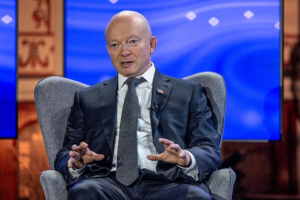
Photo: Yuccata86, CC BY-SA 4.0, via Wikimedia Commons.
Every number on this page is an estimate published by the source named next to it. We never fill in years with our own guesses. How we handle estimates.