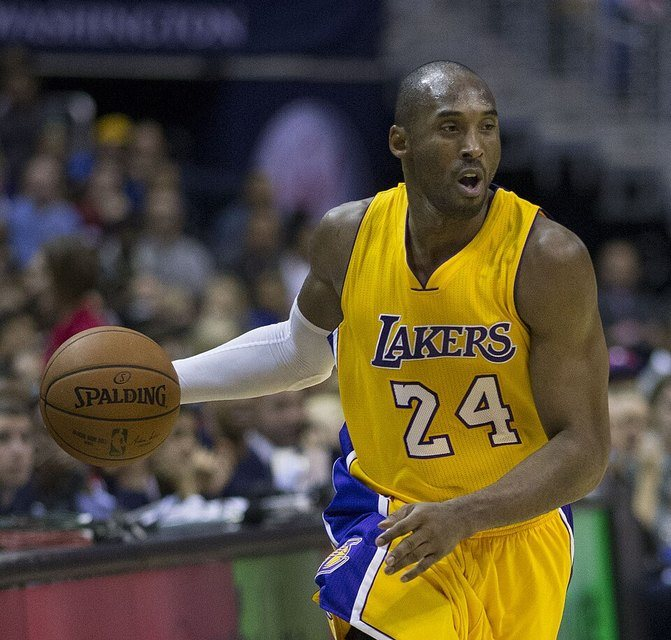
Kobe Bryant's net worth over time
Every Forbes net worth estimate we could find for him, each linked to its source. We don’t fill in the years between them.
Where the money comes from
| Career earnings | $680 million from salary and endorsements by his 2016 retirement, more than any team-sport athlete at the time (Forbes) Forbes |
| BodyArmor stake | Bought more than 10% for about $5 million in 2014; worth about $200 million after Coca-Cola invested in 2018 (Forbes) Forbes |
| Venture fund | Bryant Stibel, a $100 million fund launched in 2016 with Jeff Stibel (Forbes) Forbes |
Kobe Bryant was one of the greatest players in NBA history. He joined the league straight out of high school in 1996, spent all 20 of his seasons with the Los Angeles Lakers, won five NBA championships and retired in 2016 as one of the top scorers the game had seen. He died with his 13-year-old daughter Gianna and seven others in a helicopter crash in California on January 26, 2020.
Two days later, Forbes estimated that Bryant, at 41, had built a fortune of $600 million. Forbes had put his net worth at $350 million in December 2016, the year he retired.
How he made his money
Bryant's playing pay rose with the NBA salary cap. Forbes reported that his annual salary eventually topped $30 million and that he had the league's highest salary for six straight seasons at the end of his career. Nike was his most important partner, starting with a four-year, $40 million deal in 2003 that helped make him a superstar in China.
By the time he retired in 2016, Forbes estimated his career earnings from salary and endorsements at $680 million, more than any other team-sport athlete at that point. Only three individual-sport stars had earned more: Tiger Woods, Floyd Mayweather and Michael Schumacher.
The BodyArmor bet and life after basketball
Bryant's biggest business win was the sports drink BodyArmor. Through Kobe Inc., set up in 2013, he bought more than 10% of the company for about $5 million in 2014. When Coca-Cola invested in 2018 at a $2 billion valuation, Forbes said his stake was worth about $200 million, roughly a third of his net worth.
After retiring he launched Bryant Stibel, a $100 million venture fund, with entrepreneur Jeff Stibel, and backed companies such as The Honest Company, The Players' Tribune, Scopely and LegalZoom. He also wrote books for young readers and won an Oscar in 2018 for Dear Basketball. The $600 million headline is Forbes' estimate from January 2020, and we do not update it.
Career and money timeline
- 1996
Drafted out of high school at 17 and traded to the Los Angeles Lakers.
- 2003
Signs a four-year, $40 million deal with Nike (Forbes).
- 2014
Buys more than 10% of BodyArmor for about $5 million.
- 2016
Retires after 20 seasons and five NBA titles. Forbes estimates his net worth at $350 million.
- 2018
Wins an Academy Award for the animated short Dear Basketball.
- 2020
Dies in a helicopter crash on January 26. Forbes puts his fortune at $600 million.
Kobe Bryant net worth FAQ
What is Kobe Bryant's net worth?
Forbes estimated in January 28, 2020 that Kobe Bryant was worth $600 million. That is the most recent published estimate from Forbes that we could find; we do not update it ourselves.
Where do these numbers come from?
The net worth figure is Forbes' own published estimate, linked with its date at the top of the page. Every figure on this page is linked to its source below.
What was Kobe Bryant's BodyArmor stake worth?
Forbes reported that Bryant paid about $5 million for more than 10% of BodyArmor in 2014, and that the stake was worth about $200 million after Coca-Cola's 2018 investment valued the company at $2 billion.
Sources
- Forbes, Kobe's $600 Million Fortune: How He Scored On And Off The Court (January 28, 2020)
- Forbes, Kobe Bryant's Net Worth: $350 Million In 2016 (December 27, 2016)
- Background facts: Wikipedia, Kobe Bryant (accessed October 22, 2026). Used for career facts only, never for money figures.
Photo: Keith Allison, CC BY-SA 2.0, via Wikimedia Commons.
Every number on this page comes from the named source next to it. Totals and percentages are simple sums of those published figures. We never fill in missing years with our own guesses. How we handle estimates.